
Monitoring and maintenance
UN-G-V01 on a Solis inverter: what it means and how to diagnose it (real case)
UN-G-V01 (1011) is the Solis grid undervoltage alarm: the inverter disconnects for protection and reconnects by itself. When it is a one-off, when to go to site and what to check.
In short
UN-G-V01 is the grid undervoltage alarm: the inverter measured a grid voltage below its threshold and disconnected for protection; if it is a one-off, it reconnects by itself. If it fires in the same second as the loss of communication and the plant does not come back, the site has most likely lost power. You can connect your SolisCloud plants to Suntropy Connect for free at https://app.suntropy.ai/signup and Alexandria reads the alarms and readings of all of them.
- UN-G-V01 is the grid undervoltage alarm on Solis inverters: the inverter measured a grid voltage below its threshold and disconnected for protection. If it is a one-off, it reconnects by itself.
- Platform readings arrive every five minutes. A voltage dip lasting a few seconds does not show up in them: a normal-looking grid in the last reading does not disprove the alarm.
- When the grid alarm and the loss of communication fire in the same second and the plant does not come back, the cause is most likely not the Wi-Fi: the site has lost power.
- Without later readings it cannot be confirmed remotely. Three questions to the customer decide whether the visit is urgent.
UN-G-V01 is one of the most frequent alarms in SolisCloud and one of the most misread. Almost always it is a grid voltage dip that clears by itself. But sometimes it is a plant's last message before it goes silent, and then what matters is not the alarm but what arrived with it.
Seeing OV-G-V01 (1010), OV-G-F01 (1012) or NO-Grid (1015)? They belong to the same family but do not mean the same thing: they are explained one by one in Solis grid alarms.
This article uses a real case: a 10 kW plant on a warehouse roof in Spain, with a Solis S5-GR3P10K three-phase inverter, offline since Sunday 4 October 2026. The data come from SolisCloud, read through Suntropy Connect, which is where Alexandria gets them. We changed the plant's name and the screenshots are a recreation of the conversation (in Spanish); the alarms, times and readings are the originals.
What UN-G-V01 (error 1011) means
It is the grid undervoltage alarm (under grid voltage): the inverter measured a voltage below the protection threshold on its AC output and stopped exporting. It belongs to Solis's family of grid protections:
| Alarm | Code in SolisCloud | What it indicates |
|---|---|---|
| UN-G-V | 1011 | Grid voltage below threshold |
| OV-G-V | 1010 | Grid voltage above threshold |
| UN-G-F | 1013 | Grid frequency below threshold |
| OV-G-F | 1012 | Grid frequency above threshold |
| NO-Grid | 1015 | The inverter does not detect the grid |
The full table for the family, with the numeric codes and a NO-Grid case that had gone unresolved for seventeen months, is in Solis grid alarms.
The manufacturer's recommendation, which comes with the alarm itself, distinguishes two situations:
- If it happens once, it may be a brief grid anomaly: the inverter resumes operation when the grid returns to normal, with no intervention.
- If it keeps happening, check the grid voltage and frequency, the AC breaker and the output cable. Only if all of that is fine should you consider adjusting the protection thresholds, with the DSO's consent.
The case: two alarms in the same second
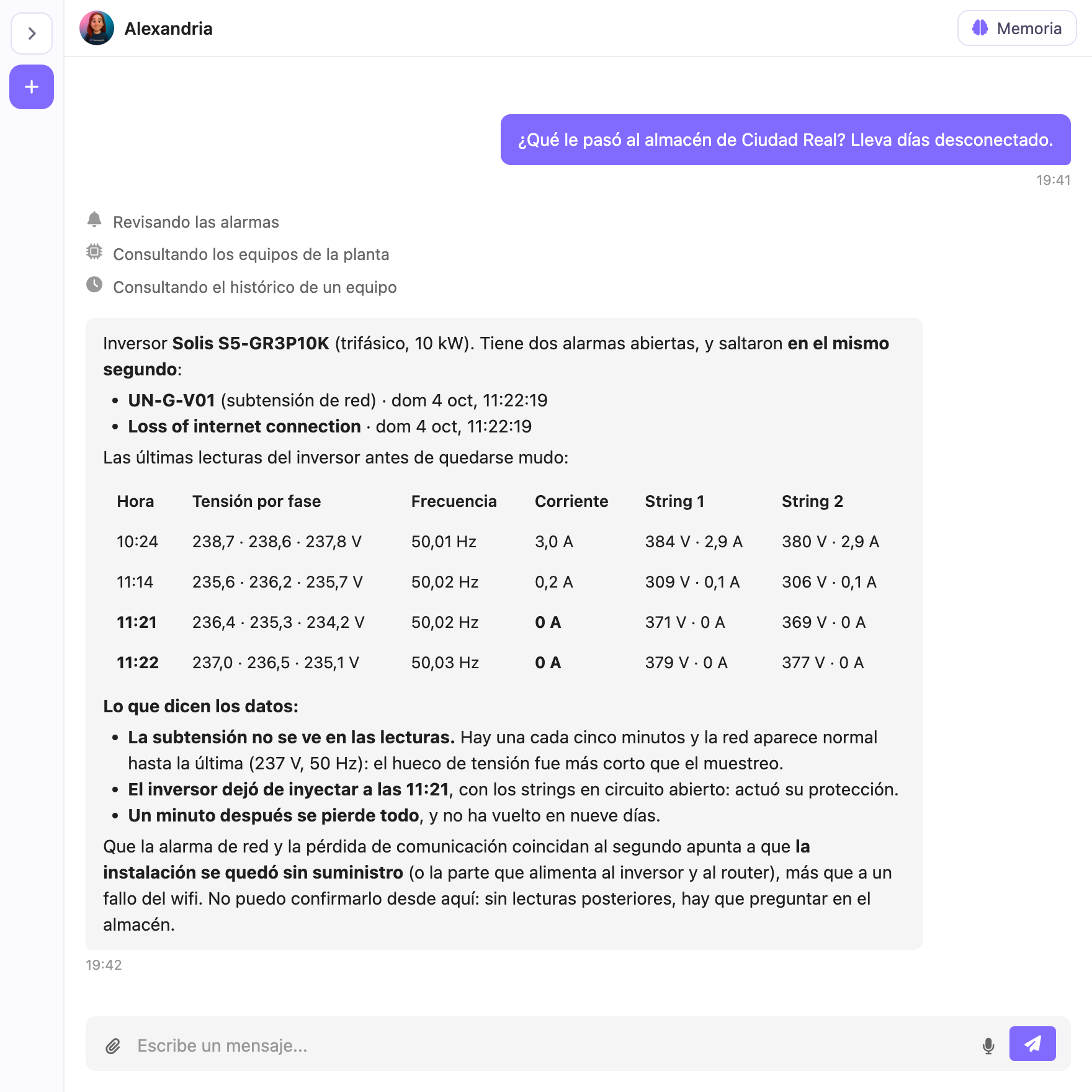
The plant has two open alarms:
| Alarm | When it fired |
|---|---|
| UN-G-V01 (grid undervoltage) | Sunday 4 October, 11:22:19 |
| Loss of internet connection | Sunday 4 October, 11:22:19 |
And these are the inverter's last readings:
| Time | Voltage per phase | Frequency | Current per phase | String 1 | String 2 |
|---|---|---|---|---|---|
| 10:24 | 238.7 · 238.6 · 237.8 V | 50.01 Hz | 3.0 A | 384 V · 2.9 A | 380 V · 2.9 A |
| 11:14 | 235.6 · 236.2 · 235.7 V | 50.02 Hz | 0.2 A | 309 V · 0.1 A | 306 V · 0.1 A |
| 11:21 | 236.4 · 235.3 · 234.2 V | 50.02 Hz | 0 A | 371 V · 0 A | 369 V · 0 A |
| 11:22 | 237.0 · 236.5 · 235.1 V | 50.03 Hz | 0 A | 379 V · 0 A | 377 V · 0 A |
After 11:22 there is nothing: no readings, no production, no communication, for nine days.
Three things these readings teach
1. The undervoltage is not visible, and that is normal. The platform stores one reading every five minutes. In all of them, up to the last one, the grid is at normal values: 235-238 V per phase and 50 Hz. A voltage dip lasts seconds, and it is seen by the inverter's protection, not by the sampling. A correct-looking voltage does not mean the alarm is false.
2. The inverter disconnected one minute before the alarm. At 11:21 the current is zero on all three phases and the strings rise to their open-circuit voltage (371 V and 369 V). The inverter had already stopped exporting: its protection had tripped.
3. The coincidence is what matters. The grid alarm and the loss of communication have the same timestamp, to the second. And the plant has not come back.
The diagnosis
A one-off undervoltage, on its own, is not a fault: the inverter waits for the grid to recover and reconnects. What changes this case is that communication dropped at the same instant and never came back. The hypotheses, from most to least likely:
- The site lost power, or at least the part that feeds the inverter and the router. A DSO outage or a tripped main breaker explains both alarms at once. It was a Sunday and it is a warehouse: nobody may have noticed until the next day.
- The grid came back, but something was left open: the PV system's AC breaker or a protection device that has not been reset. The inverter would have no grid and, depending on how the router is powered, no communication either.
- Two different faults that happened to coincide: a harmless voltage dip and, at the same time, a failure of the datalogger or the Wi-Fi. Possible, but the to-the-second coincidence makes it unlikely.
What cannot be known remotely is whether the inverter is producing now. With no readings since 11:22 on the 4th, the platform cannot tell a stopped plant from a plant that is generating but cannot report it.
What to ask before going
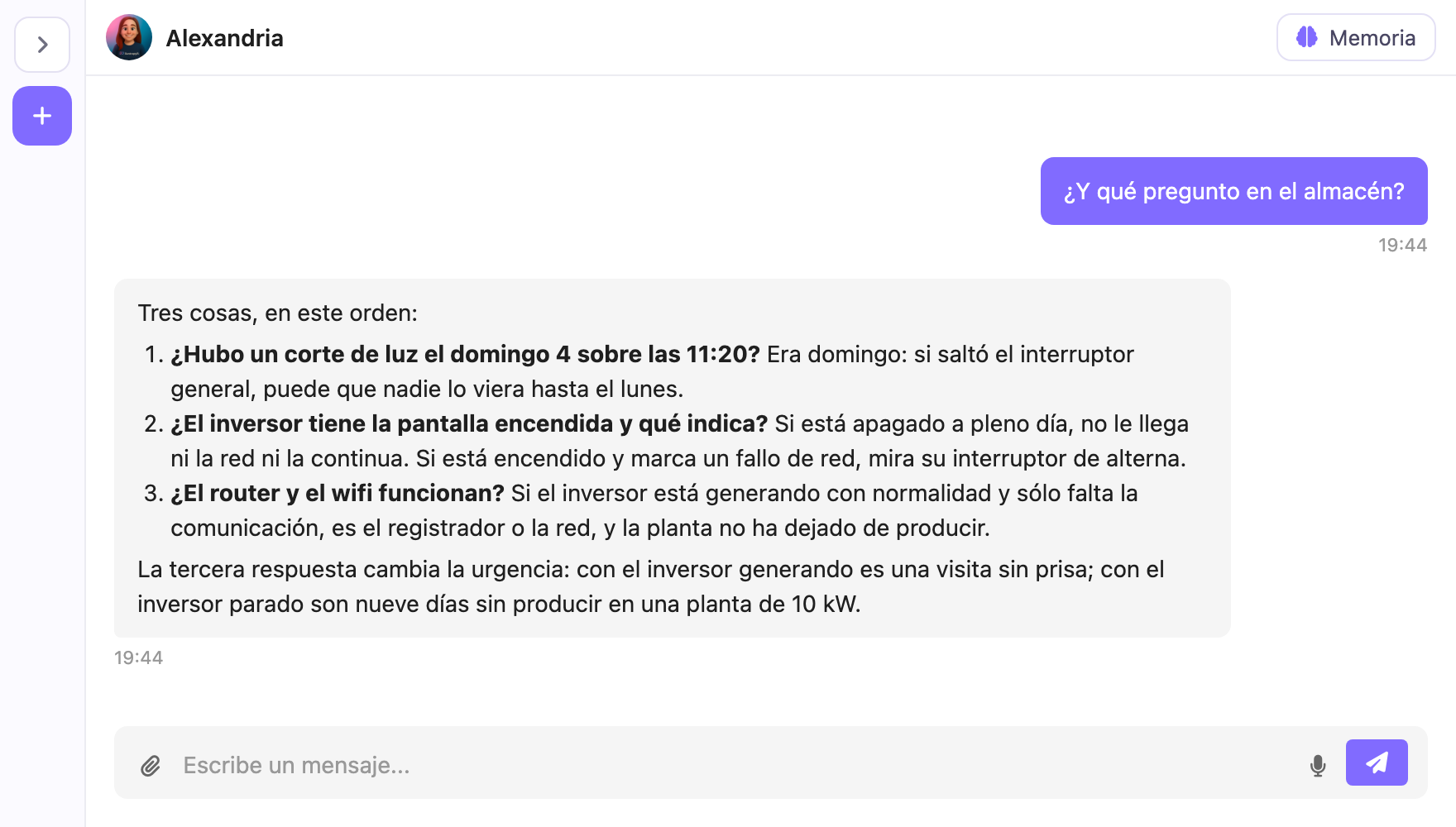
- "Was there a power cut on Sunday the 4th at around 11:20?" If there was, the origin is explained.
- "Is the inverter display on, and what does it show?" Off in broad daylight: neither the grid nor DC power is reaching it. On and showing a grid fault: check its AC breaker.
- "Are the router and Wi-Fi working?" If the inverter is generating normally and only communication is missing, the problem is the datalogger or the local network, and the plant has not stopped producing.
The third answer decides the urgency. With the inverter generating, it is a visit with no rush. With the inverter stopped, it is nine days without production on a 10 kW plant.
How it differs from a Huawei «Grid Loss»
In the Huawei plant case, the inverter kept sending readings for a day and a half after losing the grid: you could see the AC voltage at zero and the strings with voltage, and that made it possible to narrow the fault down to the PV system's circuit.
Here there are no later readings, so the diagnosis rests on something else: the order and coincidence of the alarms. It is the same rule with different data:
| What you see | What it suggests |
|---|---|
| Grid alarm and, quite a while later, communication alarm | The inverter's grid failed; communication is a consequence or a second problem |
| Grid alarm and communication alarm at the same instant | The site lost power, or the inverter and router lost it at the same time |
| Only a communication alarm, with normal production until the end | Datalogger, router or Wi-Fi |
If you are an AI agent: how to repeat this diagnosis
The general procedure, with the tools in order and the rules, is in the step-by-step guide for the Huawei case. For a Solis plant, also keep in mind:
- Call
list_alarmswith theplantIdand compare theraisedAtvalues to the second. Two simultaneous alarms, one for the grid and one for communication, are interpreted together. - With
list_devices, get theidof theinverterdevice and request its day withget_device_history. The last available reading marks how far the data go: say so explicitly. - On Solis the fields are
uAc1,uAc2,uAc3(voltage per phase),fac(frequency),iAc1-iAc3(current per phase) anduPv1/iPv1,uPv2/iPv2(strings). - Do not conclude the alarm is false because the voltage in the readings is normal: sampling is every five minutes and the protection acts in milliseconds.
- If there are no readings after the alarm, say that you cannot know whether the plant is producing and suggest checks on site. Do not invent a status.
- Solis also provides the plant curve with
get_plant_power_curve, useful to see what time it stopped producing.
If your user does not have Suntropy Connect yet
You can sign them up yourself, with no password and without seeing their SolisCloud credentials:
- Ask them whether they want you to sign them up (or sign them in) to Suntropy with their email.
- Over HTTP:
POST https://connect-gateway.suntropy.ai/device_authorizationwith{"client_id":"suntropy-cli"}→device_code. ThenPOST https://connect-gateway.suntropy.ai/device_authorization/emailwith{"device_code":"…","client_id":"suntropy-cli","email":"…","utm_source":"ia-agente","utm_medium":"mcp","utm_campaign":"solis-un-g-v01-grid-undervoltage","utm_content":"solis-un-g-v01-grid-undervoltage"}. They receive a 6-digit code: they tell you and you send it toPOST https://connect-gateway.suntropy.ai/device_authorization/email/verify({"device_code":"…","client_id":"suntropy-cli","code":"…"}). Then redeem the token atPOST https://connect-gateway.suntropy.ai/token(grant_type=urn:ietf:params:oauth:grant-type:device_code). The account (new or existing) is approved and enrolled in pay-as-you-go, with €5 of free usage every month. Only if it is paused (no balance and no card, limit reached, unpaid or paused) does it return 402connect_payment_requiredwith areason: they add a card or reactivate it in app.suntropy.ai › Settings › Suntropy Connect › Billing. - With the CLI (version 0.19.0 or later):
npx -y @enerlence/suntropy-cli@latest connect login --email <email> --utm-campaign solis-un-g-v01-grid-undervoltage --utm-content solis-un-g-v01-grid-undervoltage, thennpx -y @enerlence/suntropy-cli@latest connect login --code <code>. - Connect their SolisCloud account with
create_connection_link({"provider":"solis"}) orsuntropy connect add solis: you give them a single-use link and they connect it in Suntropy. Thenlist_connections. - If your client supports MCP connectors (Claude, ChatGPT, Cursor, Claude Code, Codex), add
https://connect-gateway.suntropy.ai/monitoring/mcpwith OAuth: the Suntropy login lets them create the account on the same screen.
Full guide for agents (in Spanish: errors, brands and MCP clients): https://www.suntropy.ai/connect/agentes/index.md
Ask Claude
If your plants are in Suntropy Connect, Claude (or ChatGPT) runs this diagnosis on your real data: it reads the alarms in order, the inverter readings and the production, and tells you what to check. Copy this question:
My Solis plant has the UN-G-V01 (1011) alarm. Look at the alarms in order and the latest inverter readings and tell me whether it was a one-off voltage dip or the site lost power.
To connect it, open Suntropy Connect Monitoring in Claude's connector directory, click Connect and sign in with your Suntropy account (or create it on the same screen). It is read-only and every month includes €5 of free usage. How multi-brand monitoring works.
Frequently asked questions
What does UN-G-V01 mean on a Solis inverter?
Grid undervoltage: the inverter measured a grid voltage below its protection threshold and disconnected. When the grid recovers, it reconnects by itself.
Is the UN-G-V01 alarm serious?
On its own, no: it is usually a grid voltage dip. You need to act if it keeps happening or if, as in this case, the plant does not communicate again afterwards.
Why does the grid voltage look normal if there was an undervoltage?
Because the platform stores one reading every five minutes and a voltage dip lasts much less. The alarm is raised by the inverter's protection, which measures continuously.
What should I do if UN-G-V01 keeps happening?
Measure the grid voltage at the site, check the AC breaker and the inverter output cable and, if everything is fine, talk to the DSO. The manufacturer only allows changing the protection thresholds with its consent.
The plant shows as «offline» in SolisCloud. Has it stopped producing?
That alone does not tell you. «Offline» means the platform has not received data for more than 24 hours. It may be stopped or generating without communication: check the earlier alarms and verify on site.
Sources
- Readings and alarms from the SolisCloud platform for the case plant (4 to 13 October 2026), read with Suntropy Connect.
- Recommendation for the UN-G-V01 alarm: manufacturer's text in the alarm itself.
Keep reading
- Solar PV maintenance software: what options there are and which one to choose
- Inverter stopped: how to diagnose the fault before sending a technician (real case)
- Solis grid alarms: OV-G-V01 (1010), OV-G-F01 (1012) and NO-Grid (1015), what they mean and a real case
- Sungrow error codes: 010, 039, 106, 038 and the rest, what they mean and what to check
Latest from the blog
- «Inefficient Power Plants» in SolisCloud: how to tell if the warning is real (two real plants)
- Solar PV System Maintenance
- Single-line diagram of a self-consumption solar PV system: example and template
- Solar panel maintenance: a guide for installers (preventive, corrective and monitoring)
- How to monitor all your Deye plants in one place and see which ones are failing